Saturday, May 18, 2013

Egyptian Studies

We decided to take a small group of afternooners on a field trip to the Kelsey Museum of Archaeology as we have been studying Africa and most specifically, Ancient Egypt. 
We hopped on the bus and headed into campus.  Our stop was right by the cube so we decided it was necessary to give it a spin before the trip inside the museum.

First, we read the rules!  When our Docent arrived, we were well prepared to answer her question of
"What are the rules of the museum?"
 We saw many, many interesting artifacts.  We even saw a child mummy!  Jean our Docent helped to explain this in a very gently, age appropriate way! 
 We saw many masks that were put on people who had died as a way to identify them.
 Here we were fascinated with a cat and hawk mummy!
 Children in ancient Egypt played with many recognizable toys!
After our tour, Jean read a book to the children called "Temple Cat." 
The children enjoyed the story and the whole field trip!
Thank you Kelsey!
 As part of our classroom study of Ancient Egypt, many children have decided to make pyramids out of sugar cubes! 
 We also used hieroglyphic stamps to write names as well as various words.
We also presented the Ancient Egypt Toob!   The children liked to interact and read (so many older children are reading independently now) about the various pieces. 

The Butterflies (well, not yet...)

 The caterpillars arrived in their plastic jar and began waking up that day.  They started eating the food in the bottom of the jar and set off to grow and grow and grow!
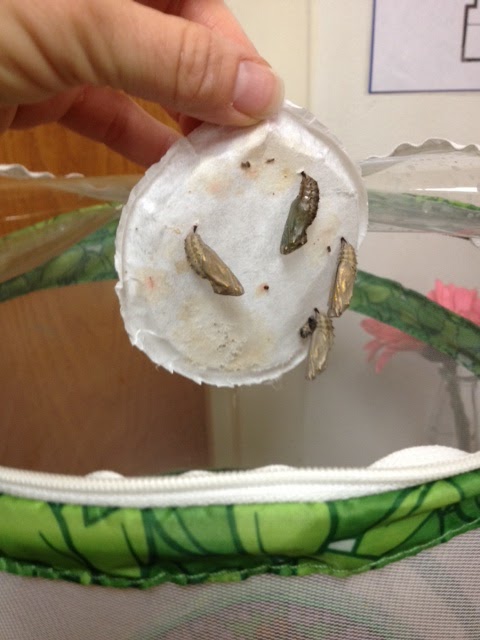
After a few days, several made the girdle and attached themselves to the paper at the top.  The children were able to see how they quickly turned into a chrysalis. 
Unfortunately one fell off and was in the bottom of the jar.  We gently picked him/her up and placed in the bottom of the habitat.  The children were really interested to see how the others stayed attached to the paper when taken out of the jar.  Many children asked me to be careful!
We then pinned the paper inside of the habitat.  Since you never know exactly how long the process will take, we made sure to leave sugar water sprinkled on some flowers at the bottom before leaving for the weekend.  The children will be quite excited to see butterflies next week.  Hopefully they will take the weekend off and decide to emerge during the school day!


Butterfly work

 This week we began studying butterflies.  We ordered caterpillars and watched them munch away at their special food.   We offered a painting work to show that butterfly wings are (mostly) symmetrical.  The child paints one side, lightly pushes it down with their hand and unfolds.
 Voila, a mostly symmetrical butterfly!
We then offered a life cycle work.  The child glues various pasta and leaves on the plate to show the egg, caterpillar, chrysalis and butterfly phases. 

Saturday, May 11, 2013

A poem for Mother's Day

The afternooners wrote a poem for their mothers yesterday.  We began this work by thinking of words that came into our mind when we thought of our mothers.
We had the children write them on sticky notes so they could be arranged and moved around.
 This is what they wrote:
Hug Kiss Cutest
Best Cook Baking
Brownies Muffins
Love
The children put a lot of thought in how to arrange the words.  It was wonderful to watch them work this out as a group. 
After the words were written, they flipped the watercolor paper over and used crayons and watercolors for a wax-resist art project.

Happy Mother's Day to all of our amazing Mothers!!

Opportunities for Writing

Writing and reading go together and we try to provide opportunities and encourage children to write. Montessori language work begins with the metal insets.  Here a child learns to hold a pencil and gain some control while creating beautiful images in many colors.  As they progress through the many works, children may want to begin writing letters.  They move on to writing their name and pretty soon various messages.  These messages can be anything from writing a sign to let others know to "take only one paper towel" to writing words in a book.  Here are some examples:
T Rex was dead in a big explosion.  To: Angela
 Mother's Day Book of Flowers
 Rose
"ar" words
 
Children are not put under pressure to spell things perfectly but encouraged to express themselves by sounding out the words.  Eventually, as they work through the language materials, they see many words and how they are spelled. 

Washing a cloth


Step 1:  Fill up the bucket.  (this is after the work has been set up and an apron or smock is put on).
 Step 2:  Get the cloth wet.
 Step 3:  Place the cloth on the board and rub soap on it. 
 Step 4:  Place the board on your belly and begin to scrub the cloth by moving it up and down.
 Step 5:  Rinse out the cloth and wring it as dry as possible.
Step 6:  Take to drying rack and use clothespins to secure. 
Step 7:  Repeat or clean up the work for the next child. 

In a Montessori environment, we encourage self-sufficiency.  Children at this age are learning to master their environment as well as the movements of their body.  Multi-step activities such as washing a cloth allows a child to have the opportunity to build confidence, independence and concentration.  At this point, most children will not be washing cloths with a washboard but this activity encourages concentration as the child becomes fully absorbed into their work.  If you were to observe this child you may have seen joy and serenity and a sense of accomplishment at the end. 


Parts of a Flower

Spring has sprung and the flowers (and everything else it seems) has bloomed! 
We study plants and flowers at this time of the year as the children are witnessing this change of season on a daily basis.  We have been planting seeds, beans and potting flowers (Happy Mother's Day) for our special Mothers!  It was time to take a closer look at a flower and see all of the various parts. 
We call this work a flower dissection. 
We take a tulip and very carefully cut the specific pieces off and place them on a black card so they are visible.  We name each part and have the children match the parts of a flower cards to the actual flower pieces. 
We gave a small group lesson on this work and the children were then allowed to complete this independently.  They were also able to complete their own parts of a flower book to take home.