Thursday, March 8, 2012

Flower Arranging

Dr. Montessori felt that children need to learn to care for their environment by sweeping, dusting, washing a table, washing windows etc.. They feel a sense of ownership as well as learn real life skills.  Children love to perform these tasks!!    In order to help make the environment beautiful, the children may choose flower arranging.

Here the child uses his scissor skills to cut open the plastic packaging.
He then put a flower in the vase to determine how far to cut the stem and then went about trimming.
A friend was nearby and very interested.  He offered to help fill up the vases with water.
After the vases were filled, the arranging could begin.
He then walked around the classroom looking for the perfect spot.
Beautiful!


Monday, March 5, 2012

The Stamp Game

This child is moving along  through the math curriculum (she is a Kindergartner) and is ready for slightly more abstract materials.  She has used the golden beads for the operation of addition and has now been introduced to the Stamp Game.  Here she uses small tiles which represents units, tens, hundreds and thousands.  In a similar way to the golden beads, two addends are written, here in colored pencil which coordinates with the tiles.  She puts the first addend down on the table. (She likes to line up the tiles perfectly with the ruler- this is something she did on her own.)

The second addend is placed below the ruler.  Once the addends are double checked, the ruler is removed and we slide the tiles up together. 
The tiles are then counted by moving them down slightly.  We always begin in the units.  This way if we go up to ten, we change ten green unit tiles in for a blue one and put it in the appropriate column. 
The sum is then recorded on the sheet. 

Mortar and Pestle work

Another kitchen tool that has become quite popular in the practical life area is the mortar and pestle.  We decided to crush graham crackers which is a fun thing to do.  We used the crumbs to make "the best snack ever!"  First, the child uses the mortar and pestle to crush the cracker (1/4 of a cracker).  They place the crumbs in the blue bowl and then cut the banana into small slices with the dull knife.  Using a toothpick, they dip a slice of banana into the crushed graham cracker and eat.  This was the highest ranked snack/food preparation item so far!


We ended up having so many crushed graham crackers, we made cheesecake!  This recipe is not too difficult, the afternoon children all helped!


We served the cheesecake to the morning children the next day.  We had mixed reviews on this one.
Here is the recipe:
YUM! 


Using a masher!


In our food preparation area, we put out mashing yams or sweet potatoes.  As we are studying Africa, we thought the children would like to taste yams or sweet potatoes (according to one report, up to 60 million people in Africa eat yams daily.) This presented a great opportunity to use another kitchen tool- the masher! (and a small spatula- see below)
Place the yam or sweet potato in the bowl.
Mash! (with a small masher)
Scrape into individual bowl. Add a little butter and a pinch of brown sugar. (not pictured)
 
Eat! 
Food preparation allows a child to become more independent and fosters self-confidence!

Thursday, March 1, 2012

The Continent of Africa

In geography, we have moved on to the continent of Africa!  Here are some things we have done so far.
The children have colored maps of Africa.  The children can really see how many countries are in this big continent! They have also begun exploring our continent puzzle map.
Flag matching is always fun!  Here the children can see all of the different flags, they are beautiful! Some children choose to make their own flags, and if you are at a Kindergarten level (or most afternooners) you may choose to make ALL the flags for a book!!!
One flag.
All of the flags!  We will make these into a book. (Just like Asia- see previous post.)
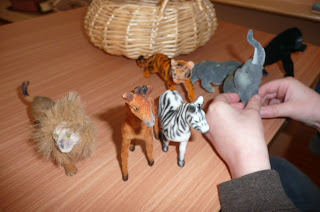
We have played with beautiful African animals.  The children love to manipulate these animals, they are soft and fuzzy.
We have some African beads and a beautiful bowl.

We have really been enjoying dancing to the Putumayo World Music from Africa too!


Fifth Vertebrate - Amphibians

We have studied the other four types of vertebrates (mammals, fish, birds and reptiles) and are now on our last one- amphibians. 
We read the children a book which helped to explain about the types and characteristics of amphibians.
Some of the children have chosen to make a "parts of the frog" book.  These books show the part colored in which isolates the part.  Some can write the words on their own and others need help.  They thought it was funny when "tail" came up but nothing was colored in.  This gave us an opportunity to talk again about how the frogs loose their tail as they progress in their life cycle.
We had a visit from our friend "big" Sophia (a fifth grader) who brought her African Dwarf Water Frogs in to see us.  This was so great, the children loved having a concrete experience of a real animal.  Sophia showed us how she feeds her frogs. 
We also made frog prints.  We gave a lesson to the afternoon children about print making and decided the morning children might like to make frog prints.
They are really cute!
The children also matched cards with various types of amphibians.


Reading Phrases

This child has progressed through understanding the phonemic sounds of letters, using the moveable alphabet to spell three letter c-v-c words, reading words and matching them to pictures (lots of 3 letter c-v-c words) and has studied sight words.  She is now ready to begin reading phrases.  Here she reads the phrase and then practices writing it down. 
She will then progress to sentences and the reading short phonemic based (like the Bob series) books.